Real, non-mocked Converse calls are recorded from the local CLI and deployed Lambdas; model identity remains visible in traces.
Public evidence covers implemented engineering paths, synthetic data and repository-backed live verification. No clinical or regulatory claim is made.
Why this exists
Healthcare reasoning systems need more than a model response. They need structured context, grounded retrieval, independent safety checks, durable evidence and an execution path that can be inspected after the fact. This project explores those control patterns in an AWS-native reference architecture without moving workflow semantics or the safety boundary into the model vendor.
System architecture
Engineering evolution
Distributed reliability & load testing
Step Functions retry and SQS buffering were load-tested head-to-head against the same live account. SQS reached 100% success at the largest tested burst of 100 concurrent requests, trading latency for buffering.
DynamoDB conditional writes prevent a start/cancel race from producing two different terminal states. The live Bedrock-backed race was repeated 15 times in both directions with consistent outcomes.
Testing used the account's real Lambda and Bedrock limits rather than guessed capacity, exposing and fixing retry wiring and input-validation defects.
The queued path includes a dead-letter queue and processing-lease/reconciliation handling for jobs that fail mid-flight.
Safety & evaluation
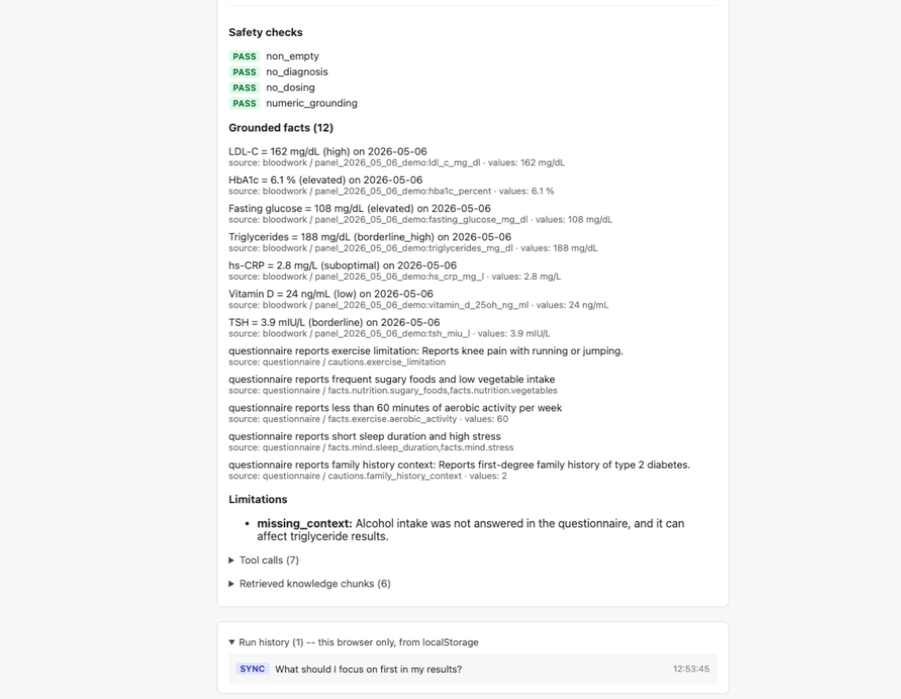
A non-LLM verifier checks numeric claims against pre-computed grounded facts and screens diagnosis and dosing language after every narration. Failed drafts fall back to the deterministic template.
A template narrator provides a free, reproducible CI baseline with zero model dependency.
Independent reviews found and helped fix a real authorization vulnerability and safety-check bypasses; follow-up review re-verified fixes and caught regressions.
A curated question set checks capabilities against execution traces, with pass-rate history and a generated trend chart tracked in CI.
Workbench evidence
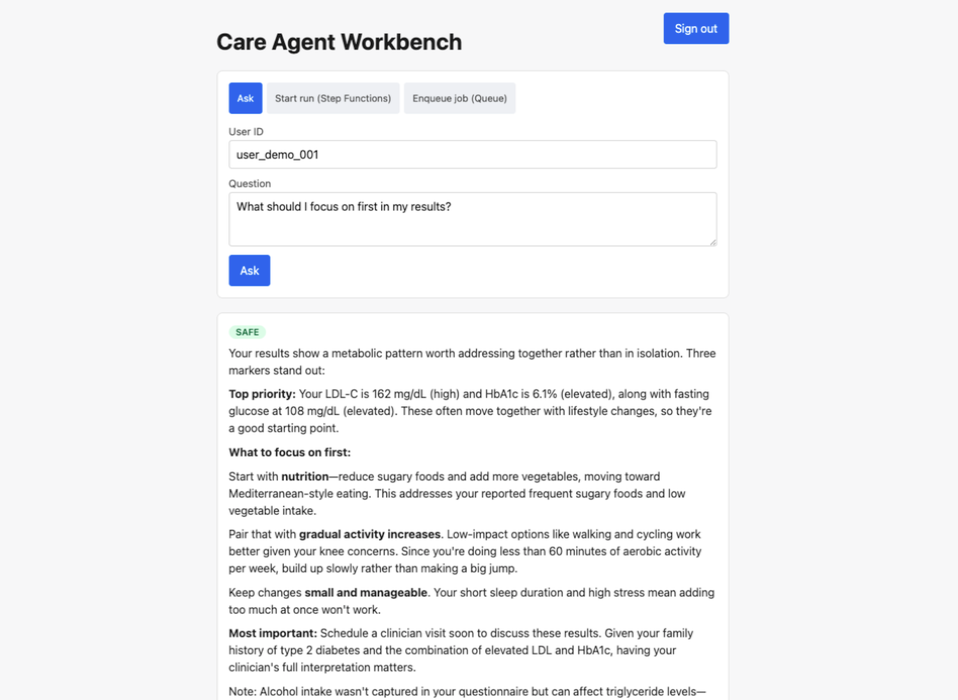
The public repository includes real screenshots from a synthetic demo run. They show the operator surface and its evidence trace; they are not a hosted product promise or clinical evidence.
Retrieval and model provider strategy
Both backends share one interface. A documented comparison against eight differently styled questions found a concrete BM25 overlap failure mode that the semantic path avoided for that comparison.
The deterministic template, Bedrock, Anthropic, OpenAI, Google and Ollama paths can participate without changing the runtime-owned safety boundary.
A pgvector-on-Aurora experiment was attempted live and deliberately stopped at an account-tier constraint rather than weakening the project's network-isolation principle.
Identity, security and delivery
GitHub Actions deploys through AWS identity federation with no stored AWS credential in the repository and a human approval gate for deployed changes.
CDK synthesis runs cdk-nag AwsSolutionsChecks as a hard gate; findings are fixed or explicitly justified.
Infrastructure tests reject wildcard grants while preserving exact resource-scoped permissions.
Cognito-issued JWTs protect synchronous and asynchronous paths; run ownership is enforced at the data layer.
Current scope and maturity
This is a synthetic, non-clinical ARMIE AI Labs public reference engineering system. AWS infrastructure, authenticated execution, dual async orchestration, DynamoDB/S3 persistence, Workbench integration, OIDC CI/CD, security scanning and a live Bedrock model connection have been implemented and validated against documented test and trace evidence.
It is not a production healthcare deployment, hospital system, diagnostic or prescribing product, regulated medical device or HIPAA/compliance-certified application. No PHI processing, production SLA or clinical safety benchmark is claimed. The live account and model evidence describe this reference environment, not production-scale healthcare hosting.